After a lot of reseach, I have learn that not all polygons can be constructed with only a ruler and a compass. This fact was proven by the mathemetician Carl Friedrich Gauss.
Only the following polygons can be constructed with a ruler and compass:
>triangle (isosceles)
>parallelogram
>pentagon
>hexagon
>heptadecagon
I have tried my best to simplify the instructions for the construction, but there are very little media resources like picture and video, so I hope you can understand what they are talking about.
Triangle
1. make a circle with a compass.
2. put the point of the compass of the circle on the edge of the first circle and make another circle
3. connect the centre of the circles and the intersection point of the circles together.
4. voila! you get a triangle.
Note: It is also possible to construct a parallelogram from this, since two of this isosceles triangles form a parallelogram.

Pentagon
1.Draw a circle and choose a point to be the pentagon's (e.g. top center)
2.Draw a guideline through it and the circle's center
3.Draw lines @ 54 degrees (from the guideline) intersecting the pentagon's point
4.Where those intersect the circle, draw lines @ 18 degrees (from parallels to the guideline)
5.Join where they intersect the circle

The following video shows you how to draw a cube, but from it you can also learn how to construct a pentagon.
Hexagon
1. Draw a circle.
2. With the same compass opening, put the point on the edge of the circle, and make two marks with the pencil on the circle.
3. Walk around the circle, placing the compass point on an existing mark and making a new one with the compass pencil, and when you're done you'll have the six points.
4. Connect the 6 points to get a hexagon
Heptadecagon
Heptadecagon is a constructable polygon, as was shown by Carl Friedrich Gauss in 1796. Gauss was so pleased by this that he asked for one to be inscribed on his tombstone. The stonemason declined, stating that the difficult construction would essentially look like a circle - so it was later decided that a star would be used on a monument honoring him instead.
1. Draw the large circle, centre O.
2. Draw a diameter AB.
3. Construct a perpendicular bisector to that diameter.
4. Bisect one of the radii on this line.
5. Bisect it again, to get point C in the diagram.
6. Draw line AC.
7. With C as a centre, draw an arc with radius CA, from A to the vertical diameter in the diagram.
8. Bisect this arc.
9. Bisect it again, to get point D in the diagram.
10. Draw line CD, which then intersects line AB at point E.
11. Construct line CF at ? to line CE, as in the diagram (so F is on AB).
12. Bisect line AF and draw the circle with AF as its diameter. This circle intersects the vertical diameter at a point G.
13. Draw the circle with centre E and radius EG. This intersects line AB at H and I.
14. Draw lines perpendicular to AB, at points H and I. These intersect the big circle at J and K.
15. Bisect angle JOK, producing point L.
16. Points J, K, L, and A are vertices of the heptadecagon. From these points, the rest of the vertices may be constructed.
That probably sounded alien. Luckily, I've got an animation.
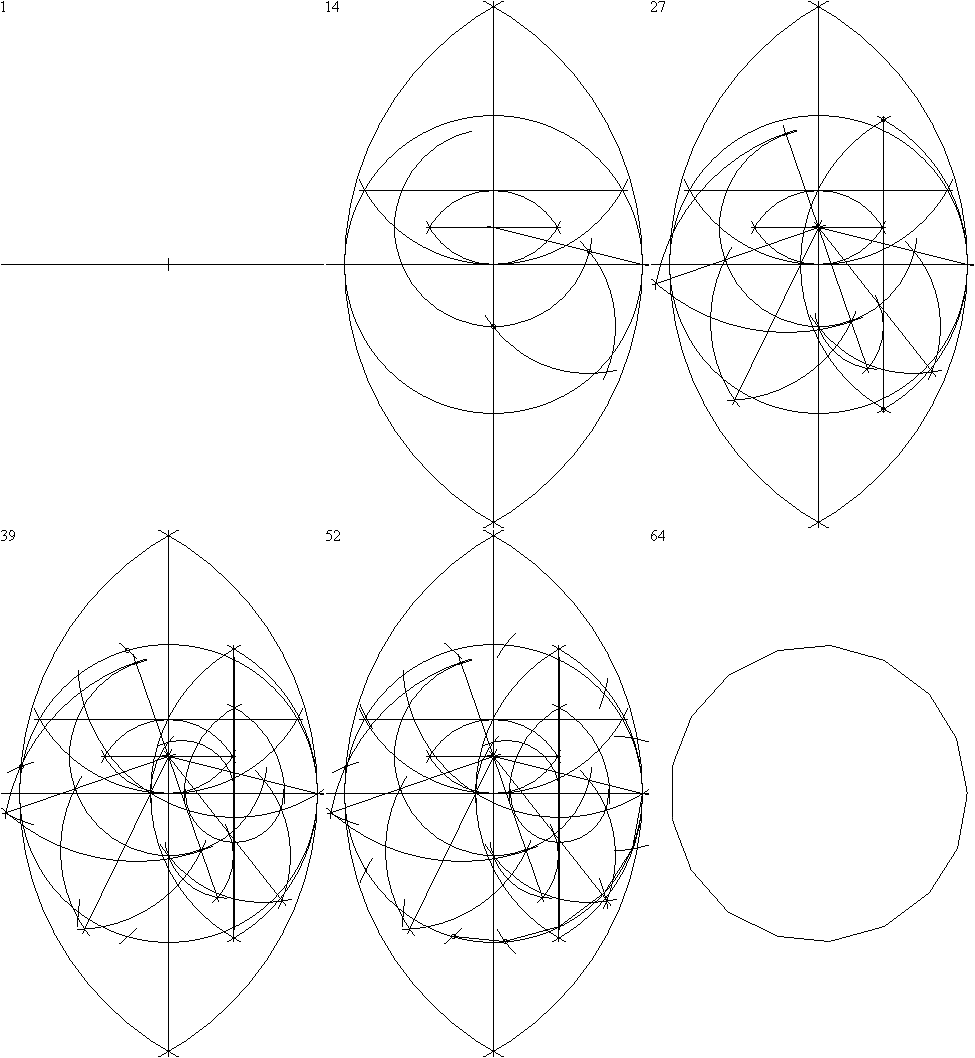
That's all that i could find on constructing simple geometric figures.
Hope you understand.
Note: If you are interested in finding out how to construct other polygons, visit this link
http://www.cyffredin.co.uk/Books%20on%20the%20Blackboard.htm
I didn't include this in my post because the examples shown there are done without the help of the compass.
Kim Yao
Credits:
http://jwilson.coe.uga.edu/EMT668/emt668.student.folders/RothJennifer/Essay3/Polygons.html http://everything2.com/title/ruler+and+compass+construction+of+regular+polygons
http://en.wikipedia.org/wiki/Pentagon
http://www.youtube.com/watch?v=Ql-yjlvv5pk